Education and comfort only. Used alongside standard care, never as a replacement for diagnosis, treatment or prescribed medicine. Benefits vary; evidence is limited for many points.
01 · Start with what you feel
Use the ear acupressure chart
Touch a point to learn
1Find the landmark2Rest a finger padShow the landmark diagram
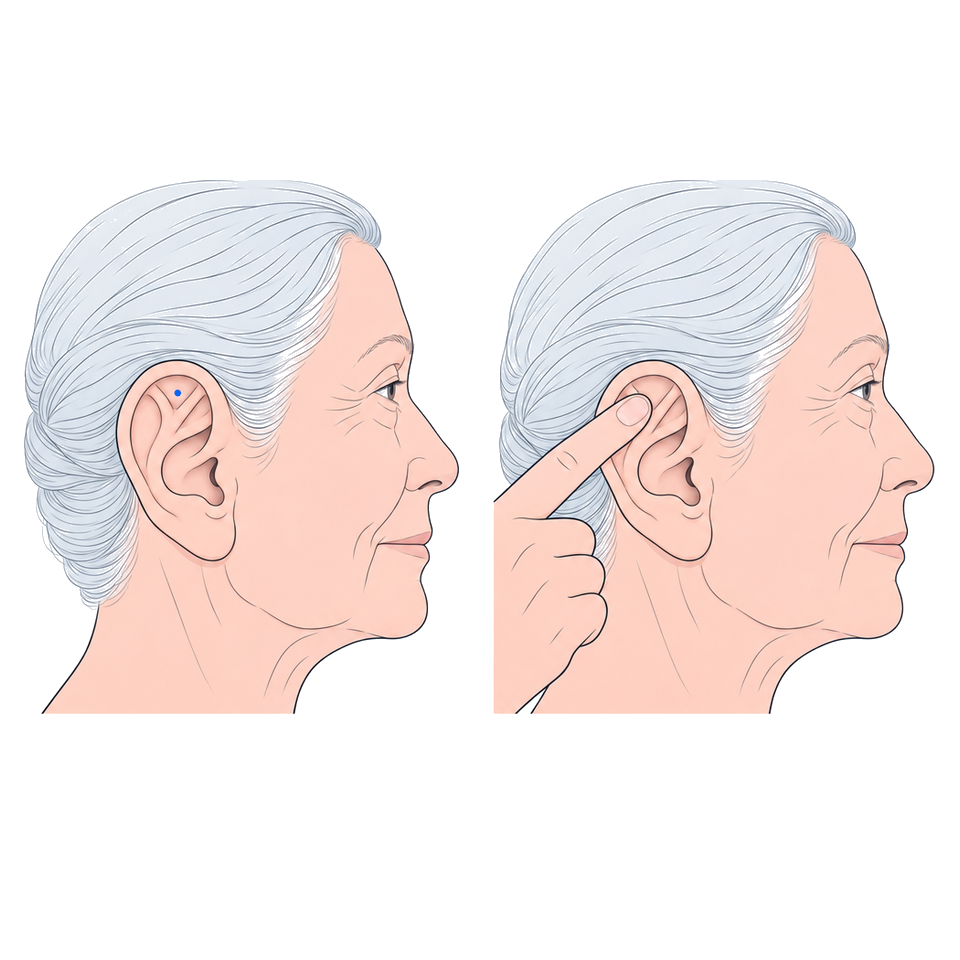
Outer Ear View Schematic, not to scale. Right outer ear. Use the written landmarks; do not guess from screen distance. Finger widths are personal estimates, not fixed inches.
EAR-SHENMEN
Evening Outer-Ear Relaxation
Ear Shenmen
Er Shenmen 耳神门
Find it in three gentle steps
1
Sit comfortably; warm clean hands together.
2
Use a mirror to find the small triangular hollow between the two upper inner ridges of the outer ear.
3
Rest a finger pad in this hollow, supporting the back of the ear if comfortable. This ear point is different from wrist HT7.
How to touch
Use a soft thumb pad: light steady touch or tiny circles for 30–60 seconds per side. Aim for no pain; never above 2–3/10. More pain does not mean more benefit. Stop for pain, dizziness, tingling or nausea.
Avoid ear pain, infection, fragile skin, healing piercings or recent ear surgery. No seeds, needles or magnets.
Location information · benefit unproven
VA describes Shen Men in provider-led auricular care. Evidence for that protocol does not prove that a finger touch here treats sleep or anxiety; this is optional comfort touch.
30 seconds on this side · then change to right ear
Sit with back supported. Use a soft finger pad on the outer ear only; stay out of the ear canal.
Breathe in gently for 4 seconds Breathe out slowly for 6 seconds No breath holding. Normal breathing is always welcome.
Soft locally generated chimes mark the start, side change and finish.
Left ear
Breathe easily, without holding or forcing your breath. The 4-second in / 6-second out rhythm is optional. Use your normal breathing if this feels uncomfortable. Stop for dizziness or breathlessness. A short comfort timer is not a clinical treatment dose.
Clear 22pt steps, a simple vector diagram and safety reminders. Each PDF fits one landscape sheet; all safety text stays at least 18pt.
Only held in this page’s memory. Never saved or uploaded.
♧ 100% Private: Generated in your browser, nothing uploaded
Large-print paper preview · 24pt names / 22pt steps
Paper proof · US Letter · landscapeFull-size safety text · nothing clipped
A quiet minute · bedside editionGentlePoints · Gentle self-care
100% Private: Generated in your browser, nothing uploaded
EAR-SHENMEN · Ear Shenmen
Er Shenmen
Warm clean hands.
Find upper triangular ear hollow.
Rest a finger pad on outer ear only.
No seeds or objects in ear canal.
Upper triangular hollow · Outer ear only
Light thumb-pad touch or tiny circles: 30-60 seconds per side. No pain; never above 2-3/10. More pain is not more benefit. Stop for pain, dizziness or tingling.
Comfort only. Organ maps cannot diagnose, treat or reverse heart disease, high blood pressure, diabetes or kidney disease. Never stop or reduce prescribed medicine. Sources: MSKCC/VA, NIH; WHO locations only.
Outer ear / forehead only. No seeds or objects in the ear canal. Never press eyes.
Call 911 / Seek Immediate Medical Care
Sudden severe headache (the worst headache of your life); chest pain/pressure or shortness of breath; sudden weakness/numbness on one side or slurred speech; sudden dizziness/fainting; vomiting blood or persistent severe vomiting.
US: 911. Elsewhere: local emergency number (EU: 112). Do not try pressure first.
General Safe Touch Rules
Never press over open wounds, rash, skin infection, varicose veins, suspected blood clots (DVT), recent fractures or surgical sites. Avoid numb areas and red, hot, swollen or painful joints during an acute arthritis flare.
Taking blood thinners (e.g., warfarin, apixaban, aspirin), or bruising easily? Use feather-light touch only. Stop if bruising occurs; ask your clinician if unsure.
https://gentlepoints.org
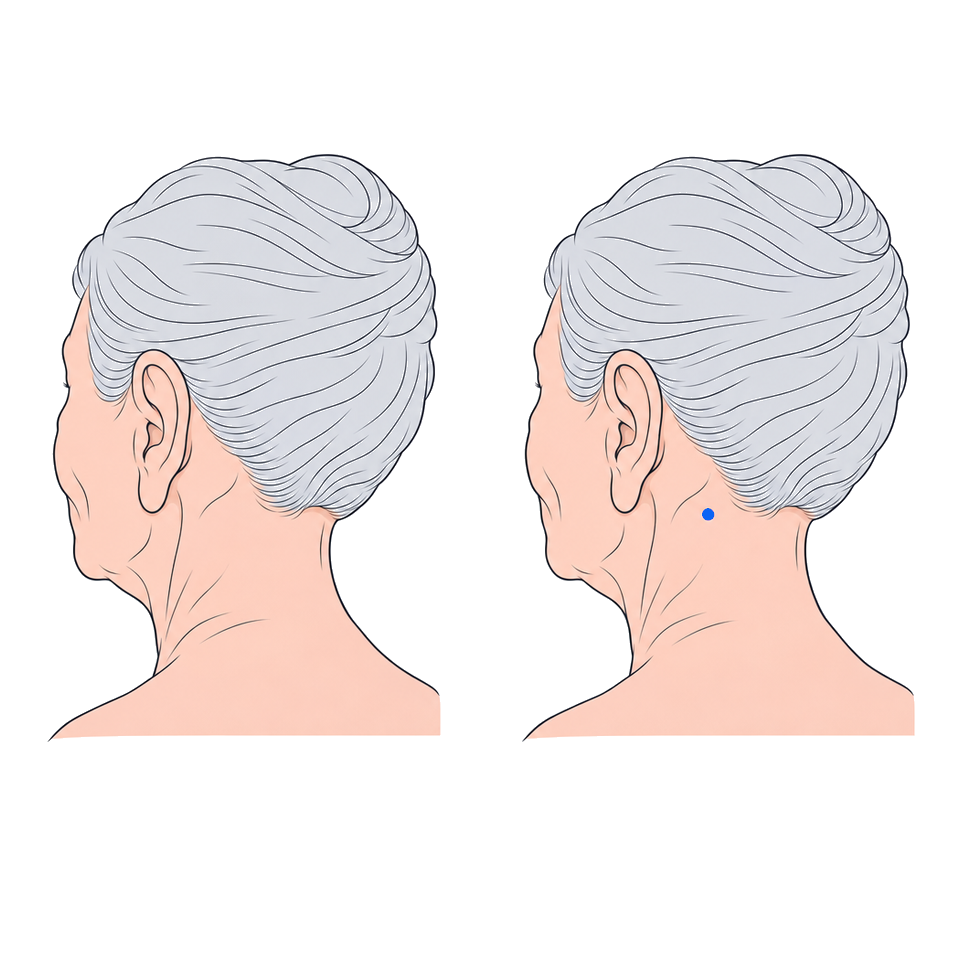
1Behind the ear2Upper-neck landmark
Anatomical reference
Anmian · 安眠
In an acupuncture research protocol, Anmian lies behind the ear midway between the hollow just behind the earlobe (Yifeng) and the hollow at the rear skull base (Fengchi).
Use this picture to recognize the area. Skip neck pressure. The source describes a clinician-led procedure.