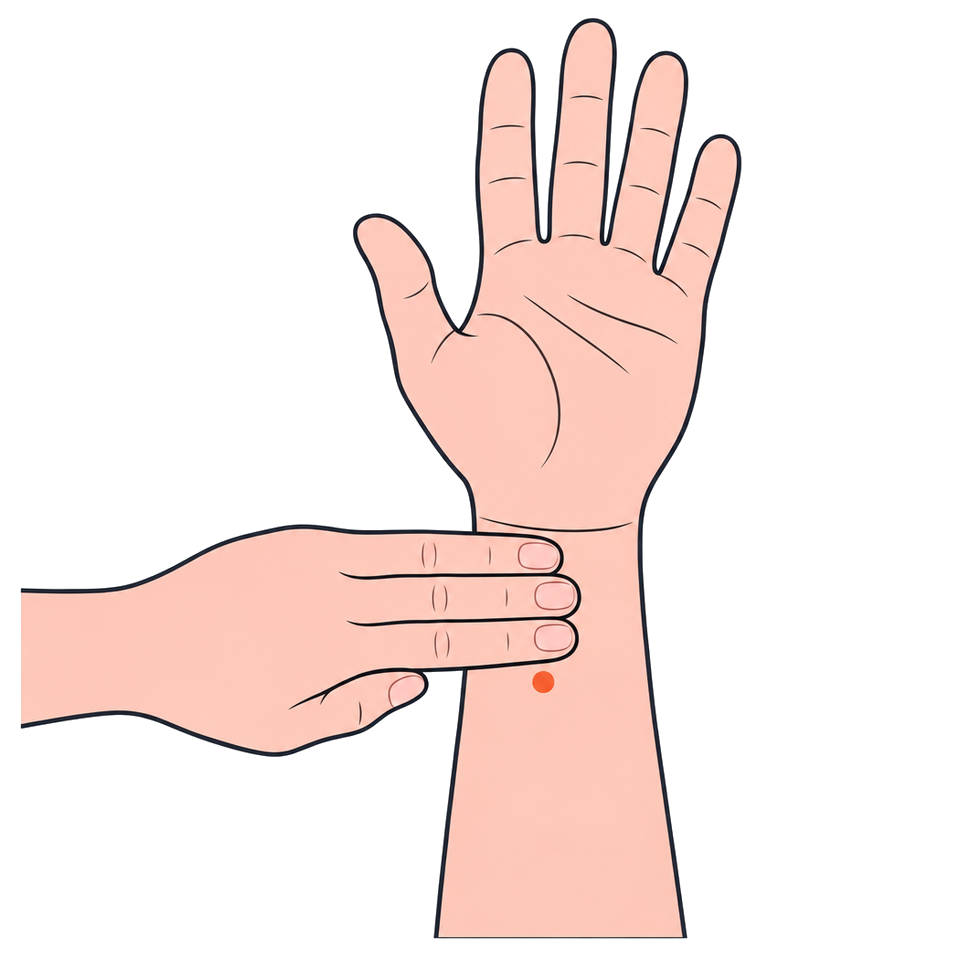
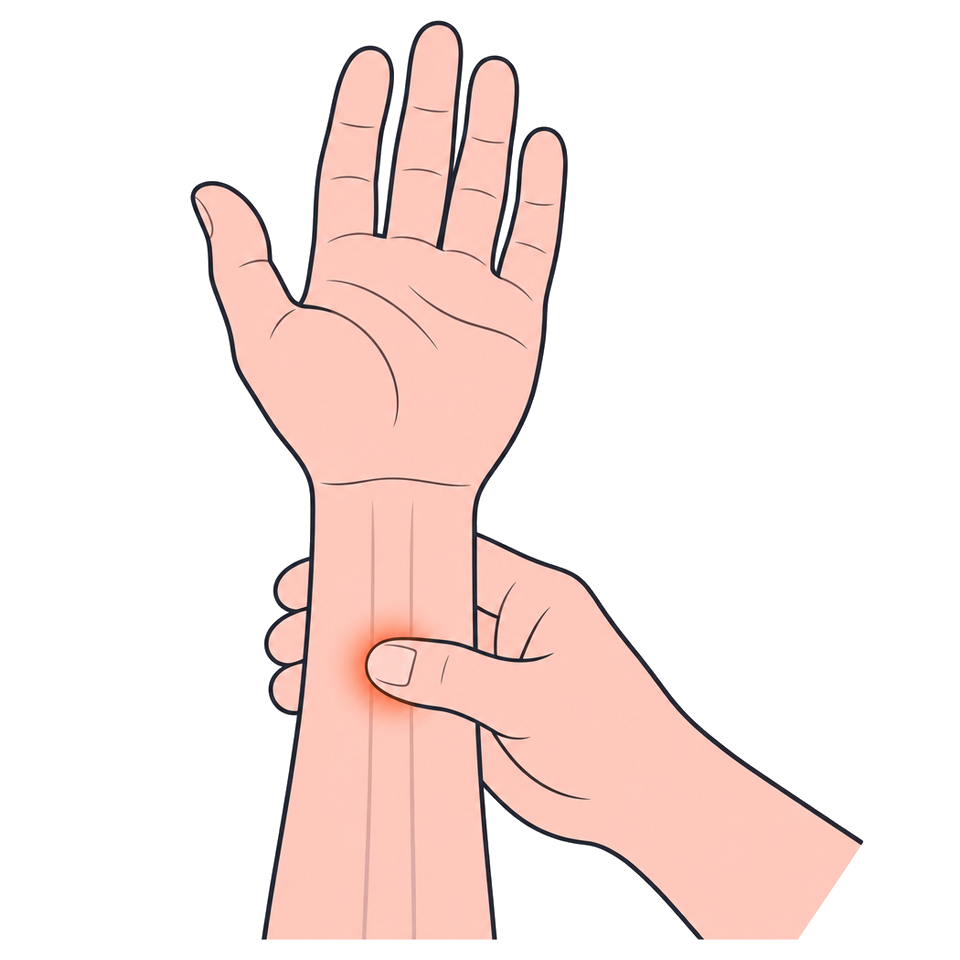
Illustrations show hand positioning, not a diagnosis or a precise anatomical measurement. Follow the written landmarks.
Prepare, find and touch
Prepare. Rest your forearm on a table, palm facing up. Find the wrist crease.
1
Lay your other index, middle and ring fingers together across the forearm, starting at the crease and moving toward your elbow.
2
Rest your thumb pad in the soft gap between the two central tendons, just beyond those fingers. The distance is a personal estimate, not a fixed inch measurement.
How to touch
Use a soft thumb pad: light steady touch or tiny circles for 30–60 seconds per side. Aim for no pain; never above 2–3/10. More pain does not mean more benefit. Stop for pain, dizziness, tingling or nausea.
30 seconds on this side · then change to right hand
Rest your arm. Keep pressure light and comfortable.
Breathe in gently for 4 seconds Breathe out slowly for 6 seconds No breath holding. Normal breathing is always welcome.
Soft locally generated chimes mark the start, side change and finish.
Left hand
Breathe easily, without holding or forcing your breath. The 4-second in / 6-second out rhythm is optional. Use your normal breathing if this feels uncomfortable. Stop for dizziness or breathlessness. A short comfort timer is not a clinical treatment dose.
Clear 22pt steps, a simple vector diagram and safety reminders. Each PDF fits one landscape sheet; all safety text stays at least 18pt.
Only held in this page’s memory. Never saved or uploaded.
♧ 100% Private: Generated in your browser, nothing uploaded
Large-print paper preview · 24pt names / 22pt steps
Paper proof · US Letter · landscapeFull-size safety text · nothing clipped
A quiet minute · bedside editionGentlePoints · Gentle self-care
100% Private: Generated in your browser, nothing uploaded
PC6 · Inner Pass
Neiguan
Prepare. Rest palm up.
Measure 3 fingers up forearm.
Touch between the two tendons.
Skip numb or irritated skin.
Wrist crease · Two central tendons
Light thumb-pad touch or tiny circles: 30-60 seconds per side. No pain; never above 2-3/10. More pain is not more benefit. Stop for pain, dizziness or tingling.
Comfort only. Organ maps cannot diagnose, treat or reverse heart disease, high blood pressure, diabetes or kidney disease. Never stop or reduce prescribed medicine. Sources: MSKCC/VA, NIH; WHO locations only.
Call 911 / Seek Immediate Medical Care
Sudden severe headache (the worst headache of your life); chest pain/pressure or shortness of breath; sudden weakness/numbness on one side or slurred speech; sudden dizziness/fainting; vomiting blood or persistent severe vomiting.
US: 911. Elsewhere: local emergency number (EU: 112). Do not try pressure first.
General Safe Touch Rules
Never press over open wounds, rash, skin infection, varicose veins, suspected blood clots (DVT), recent fractures or surgical sites. Avoid numb areas and red, hot, swollen or painful joints during an acute arthritis flare.
Taking blood thinners (e.g., warfarin, apixaban, aspirin), or bruising easily? Use feather-light touch only. Stop if bruising occurs; ask your clinician if unsure.
https://gentlepoints.org
01 Use primary clinical education; distinguish location from benefit.02 Reject organ-map myths; continue prescribed care.03 Check emergencies and individual cautions before touching.04 Use anatomical landmarks, light touch and stable seated support.
A little clarity, a lot of care
What Science Supports vs. Reflexology Myths
✓ Support for gentle self-care
Gentle touch stimulates sensory nerves and may feel relaxing. MSKCC teaches PC6 for nausea and LI4 for pain/headache support; VA teaches self-care for winding down. Clinical use is not proof that every mapped point works, or that one mechanism explains all benefits.
Touch may support comfort alongside your usual care. A point’s traditional name does not establish an organ connection.
× Organ maps are not medical tests
Palm or sole “heart, liver or pancreas zones” cannot diagnose, treat or reverse heart disease, high blood pressure, diabetes or kidney disease. Never stop or reduce prescribed medicine because you use acupressure.
New, persistent or worsening symptoms deserve a clinician’s attention.
Can a hand reflexology chart diagnose an organ problem?
No. Palm and sole organ maps cannot diagnose, treat or reverse heart disease, high blood pressure, diabetes or kidney disease. Continue prescribed medicines and seek medical assessment for symptoms.
How hard should I press?
Use comfortable light touch. Aim for no pain and never above 2–3 out of 10. Pain is a signal to stop, not a sign of effectiveness. With blood thinners or easy bruising, use feather-light touch only.
Is every point backed by clinical evidence?
No. MSKCC and VA publish self-care handouts for selected points. A clinical handout is not a guarantee of benefit. WHO point locations are not proof of effectiveness. Other areas are labeled location-only or comfort-only.
Does my printed card send personal information anywhere?
No. The PDF is created in your browser, and the optional dedication stays in page memory. Only reading preferences are saved locally. External source links and your printer are outside this app.